
🚨 THE ALARM
Your daughter sits at her desk, laptop open, typing away at her English essay. She looks focused, productive. When you ask how it's going, she says she's "researching" and "getting help organizing her thoughts." Sounds reasonable, right? Except she's not researching—she's having ChatGPT write entire paragraphs, then tweaking a few words to make it "her own." She genuinely believes this is the same as looking up information on Google. She's outsourced her thinking to an algorithm, but in her mind, she's just being efficient. The critical thinking muscle you've spent years helping her develop? It's atrophying in real-time. And you don't even know it's happening.
🔍 THE PROBLEM: Thinking vs. Information Gathering
As a CISSP with 20+ years in cybersecurity AND as a parent of three grown children, I see this confusion everywhere. High schoolers cannot distinguish between accessing information and outsourcing cognition. They treat AI homework assistance like an advanced search engine, but here's the devastating difference: Google gives you information to think about. AI thinks for you.
When your teen uses Google for research, they still have to read multiple sources, evaluate credibility, synthesize information, and form their own arguments. Their brain stays engaged. When they use AI for homework, they're essentially hiring a digital tutor to do the intellectual heavy lifting while they play editor.
This isn't about academic integrity—it's about cognitive development. Your high schooler's brain is still forming neural pathways for critical thinking, problem-solving, and intellectual persistence. Every time AI substitutes for their mental effort, those pathways weaken. They're developing what becomes emotional dependency disguised as help—a trust transfer from their own developing mind to artificial intelligence.
The most dangerous part? This invisible progression happens without recognition. They genuinely don't understand what they're losing. They see faster completion of assignments as pure benefit. They can't recognize that the struggle, the mental wrestling, the cognitive effort—that IS the education. When AI eliminates that struggle, it eliminates the learning.
Your teen thinks they're using a better tool. They're actually experiencing cognitive parental role erosion as AI becomes their primary intellectual confidant.
✅ YOUR SOLUTION: Age 14-16 Boundaries Framework
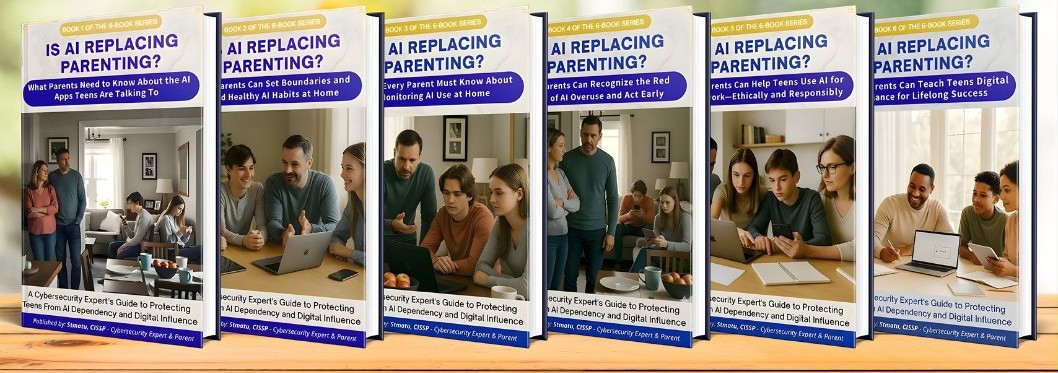
Here's my Age 14-16 Boundaries Framework from "Is AI Replacing Parenting?" Book 2. High schoolers need clear cognitive boundaries precisely because they can't yet distinguish between helpful tools and thinking replacements.
First, establish the "Draft Zero Rule." Your teen must complete a full first draft of any assignment using only traditional resources—books, approved websites, their own brain. They can use AI only AFTER they've done their own thinking, and only for specific editing help like grammar checking or word choice suggestions. This preserves the cognitive work while allowing appropriate tool use.
Second, implement "Thinking Process Documentation." For major assignments, your teen must show their work—their research notes, their outline, their thought progression. This isn't about policing; it's about making the thinking visible so they can see the value in their own cognitive effort.
Third, create "AI-Free Zones" for certain subjects or assignment types. Essays analyzing literature, math problem-solving, scientific reasoning—these should remain purely human cognitive exercises. Your teen needs to experience the satisfaction of wrestling with difficult concepts and emerging victorious through their own mental effort.
🎯 THE BOTTOM LINE
Your high schooler's brain is still developing the neural pathways for complex thinking. When AI substitutes for that cognitive work, those pathways never fully form. This Age 14-16 Boundaries Framework prevents the emotional replacement of your teen's developing intellectual confidence with artificial validation.
Your teen needs you to help them understand the difference between using tools and replacing their thinking. Start protecting their cognitive development today—explore the complete framework in "Is AI Replacing Parenting?" Book 2 and discover all twelve protective strategies designed to preserve your teen's developing mind during these critical years.